How to Get a Mortgage When You Are Self-Employed in Florida
By Toni Taylor Gozza, Senior Loan Originator and Owner | Interconnect Mortgage Inc. | NMLS #274323
If you are self-employed in Florida and you have tried to get a mortgage, you have probably run into the same wall. The bank looks at your tax returns, sees your income after write-offs, and tells you that you do not qualify. So you walk away thinking the mortgage market just does not work for people like you.
That is not true. You talked to the wrong lender.
Today I am breaking down every mortgage option available to self-employed borrowers in Florida right now. From the traditional path that actually does work in some cases, to non-QM programs most banks have never even heard of.
Why Do Banks Make It So Hard for Self-Employed Borrowers?
Let me explain the real problem first, because understanding it changes everything.
The traditional mortgage system was built around W-2 income. Show up with a pay stub, a tax return, and a clean income line. Employment verified. Done.
Self-employed borrowers are different. You control your write-offs. You have a business structure. What you report to the IRS after deductions is often a fraction of what you actually earn. So when a conventional lender uses your adjusted gross income to calculate your qualifying income, they are using the lowest possible version of your actual earnings.
The tax strategy that saves you thousands every April is the same thing that limits your mortgage options at a traditional bank.
Can Self-Employed Borrowers Still Get a Conventional Mortgage?
Yes, in some cases. The conventional path is not always a dead end.
If you have been self-employed for at least two years, your income is growing year over year, and your net income after write-offs still supports the loan, a conventional or FHA mortgage may be possible.
Here is what that looks like. You will need:
- Two years of personal and business tax returns
- Year-to-date profit and loss statement
- Business bank statements
- Personal bank statements
The lender will average your income over two years. If your net income supports the payment, you are fine. If your write-offs are aggressive, which they probably should be for tax purposes, this path gets frustrating fast.
That is where non-QM programs come in.
What Is a Bank Statement Loan?
The bank statement loan is one of the most widely used solutions for self-employed borrowers in Florida right now.
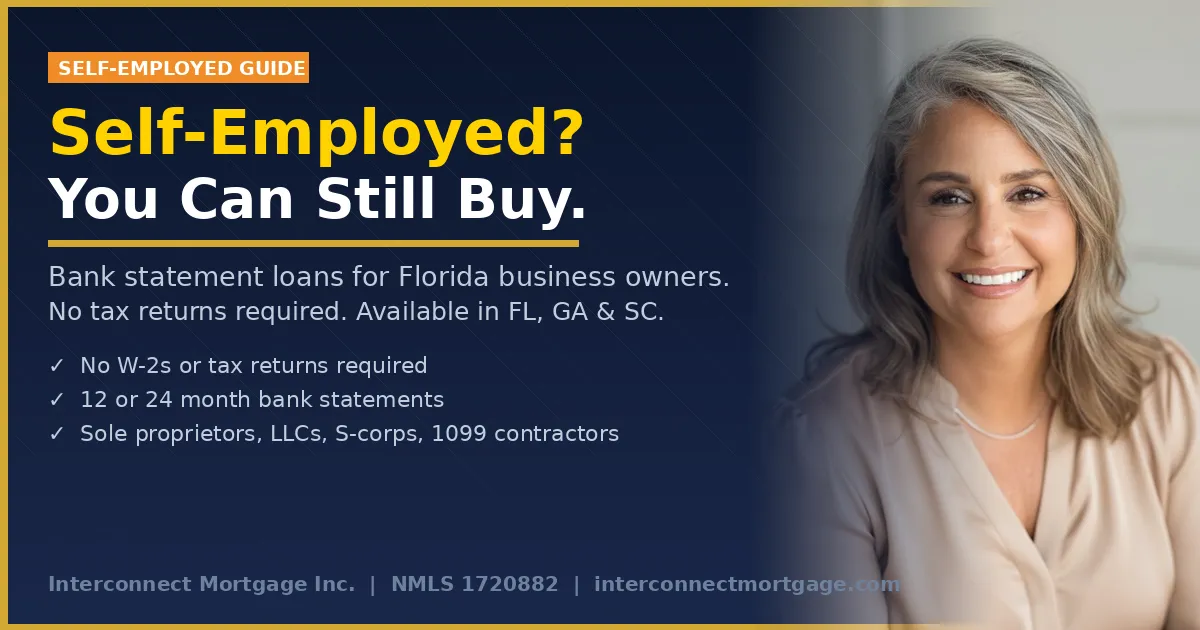
Instead of qualifying based on tax return income, you show 12 or 24 months of bank statements. The lender calculates your average monthly deposits, applies an expense ratio, and uses that as your qualifying income. No tax returns. No W-2s. No employment verification.
Here is how the math works. Say your business account shows an average of $20,000 a month in deposits. The lender applies a 50 percent expense ratio, leaving $10,000 a month as qualifying income.
On a personal account, most programs count 100 percent of your deposits.
Typical bank statement loan parameters:
- Minimum credit score: usually 620 to 660
- Down payment: 10 to 20 percent
- Loan amounts: up to $3 million on some programs
- Documentation: 12 or 24 months of bank statements
This program was built for people like you. Not for people with a W-2.
What Is a 1099 Loan?
If you are a 1099 contractor, real estate agent, insurance agent, consultant, or freelancer, there is a separate program for you.
The 1099 loan uses your 1099 income from the past one or two years to calculate qualifying income without requiring a full tax return analysis. This is a cleaner path for borrowers whose income is well documented through 1099 filings.
You do not have to hand over years of business tax returns. The 1099s speak for themselves.
What Is a DSCR Loan and Who Qualifies?
If you are also a real estate investor, the DSCR loan is a game changer.
DSCR stands for Debt Service Coverage Ratio. These loans do not look at your personal income at all. The lender qualifies the property based on its rental income. If the rent covers the mortgage payment at a ratio of 1.0 or better, you qualify.
No business returns. No personal income documentation. No employment verification of any kind.
For self-employed borrowers who want to build a rental portfolio without their tax write-offs getting in the way, DSCR is one of the most direct paths available.
What Do Lenders Look at for Self-Employed Mortgages?
Across all the programs above, lenders look at the same core factors. These are the pieces that matter most.
Credit Score
Most non-QM programs start at 620. Your options and your interest rate improve meaningfully at 680 and above.
Down Payment
Bank statement and non-QM programs typically require 10 to 20 percent down. Stronger files with higher credit scores can sometimes go lower.
Reserves
Most programs want to see 3 to 12 months of mortgage payments sitting in an account after closing. This is your cushion, and lenders want proof it is there.
Income Consistency
Lenders want to see stability and growth, not erratic deposits and big gaps. Two years of self-employment is the standard requirement on most programs.
\Why Going to a Big Bank First Is the Mistake
If you went to a big bank and you got turned down, that is not the full picture. Banks have a limited menu. They do not offer bank statement loans. They do not offer 1099 programs. Most do not offer DSCR loans.
When they say no, they are saying no to their products. Not to the entire mortgage market.
A mortgage broker works with dozens of lenders across multiple categories. That access is the core value of working with a broker instead of a retail bank. You get options your bank cannot offer.
Why Florida Is a Strong Market for Self-Employed Mortgages
Florida has one of the highest concentrations of self-employed workers in the country. The non-QM market here is strong, competition between lenders is healthy, and programs are available for qualified borrowers.
We work with self-employed borrowers across Florida, Georgia, and South Carolina every week. This is one of our most common file types. We know how to position these loans and which programs work for which situations.
Frequently Asked Questions
Can I get a mortgage if my tax returns show low income due to write-offs?
Yes. Non-QM programs like bank statement loans, 1099 loans, and DSCR loans do not rely on adjusted gross income from your tax returns. They use alternative documentation like bank deposits, 1099 filings, or rental income to calculate your qualifying income. Your write-offs do not penalize you on these programs.
What credit score do I need for a bank statement loan in Florida?
Most bank statement loan programs start at a 620 credit score. Terms and interest rates improve at 680 and higher. Some programs accept lower scores with stronger compensating factors like a larger down payment or significant cash reserves.
How many months of bank statements do I need for a self-employed mortgage?
Most bank statement loan programs require 12 or 24 months of business or personal bank statements. Some programs allow shorter timeframes with strong credit and reserves. The exact requirement depends on the lender and the program you use.
Can a 1099 contractor qualify for a mortgage in Florida?
Yes. 1099 loans are designed specifically for independent contractors, real estate agents, insurance agents, consultants, and freelancers. The loan uses your 1099 income from the past one or two years as qualifying income, without requiring a full tax return workup.
What is a DSCR loan and do I need personal income to qualify?
A DSCR loan is a mortgage for real estate investors that qualifies based on the rental income of the property instead of your personal income. You do not need personal income documentation, tax returns, or employment verification. If the rent covers the mortgage payment, you qualify.
How much do I need to put down on a self-employed mortgage?
Most non-QM programs for self-employed borrowers require 10 to 20 percent down. Stronger credit profiles and larger cash reserves can sometimes qualify for lower down payments. Conventional and FHA options may be available with less down if your net income after write-offs supports the loan.
Ready to See What You Actually Qualify For?
Stop letting a single bank rejection define what is possible. Self-employed borrowers in Florida have real options, and working with the right lender is the whole ballgame.
Step one. Download the free [Pre-Approval Checklist](https://interconnectmortgage.com/pre-approval-checklist). It tells you exactly which documents to gather for each program type.
Step two. [Book a free strategy call](https://interconnectmortgage.com/calendar). We will review your income structure, your deposit history, your credit profile, and your goals. Then we will tell you exactly which programs are available to you and what you actually qualify for. No pressure. No obligation. Straight answers.
Step three. Want to run the numbers first? Use our free [home affordability calculator](https://interconnectmortgage.com/affordability-calculator) to get a planning number before you book the call.
If you are self-employed in Florida, Georgia, or South Carolina, we are here to help.
Toni Taylor Gozza
Senior Loan Originator and Owner
Interconnect Mortgage Inc.
5220 Hood Rd Suite 110
Palm Beach Gardens, FL 33418
561-556-7109
Book a strategy call: interconnectmortgage.com/calendar
Toni Taylor Gozza NMLS #274323
Interconnect Mortgage Inc. NMLS #1720882
5220 Hood Rd Suite 110
Palm Beach Gardens FL 33418
561-556-7109
Equal Housing Lender
Licensed in Florida, Georgia, and South Carolina
NMLS Consumer Access: nmlsconsumeraccess.org
This material is not from HUD or FHA and has not been approved by any government agency. For information directly from HUD or FHA visit hud.gov/guidance.
Loan program guidelines, interest rates, and qualification requirements are subject to change. All examples are illustrative only and do not represent actual loan terms. Contact us for current qualification criteria specific to your situation.
Privacy Policy | Terms & Conditions | Complaints Policy
© Copyright 2025 | Interconnect Mortgage Inc. | All rights reserved.